
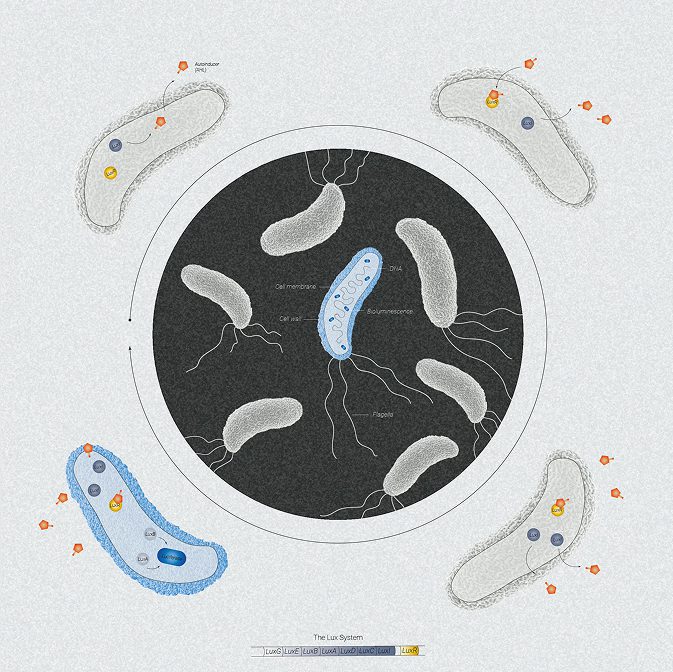
Aliivibrio Fischeri is a single-celled, Gram-negative marine bacterium capable of bioluminescence. Heterotrophic and motile employing a single polar flagellum, some colonies float freely in the oceans and feed on decomposing organic matter. Still, very often, this bacterium forms symbioses with marine organisms. Marine organisms contain bioluminescent bacteria to find mates, ward off predators, attract prey or communicate with other organisms. In return, the organism provides the bacteria with a nutrient-rich environment.
The bioluminescence of A. Fischeri is caused by the transcription of the lux operon which consists of seven structural genes. These are organized as luxCDABEGH. The lux operon is induced by population-dependent quorum sensing. The population of A. Fischeri must reach an optimal level to activate the lux system and stimulate light production.